
The modern corporate response to the hazards of prolonged sitting has largely settled on mechanical compromise. Sit-stand converters, engineered to lift an existing workstation a few dozen centimeters via pneumatic springs or counterweights, now populate corporate offices as standard equipment. They offer an accessible entry point to postural variation, requiring neither floor space expansion nor significant behavioral modification, yet their operational reality often falls short of the physiological transformation promised by their marketing materials.
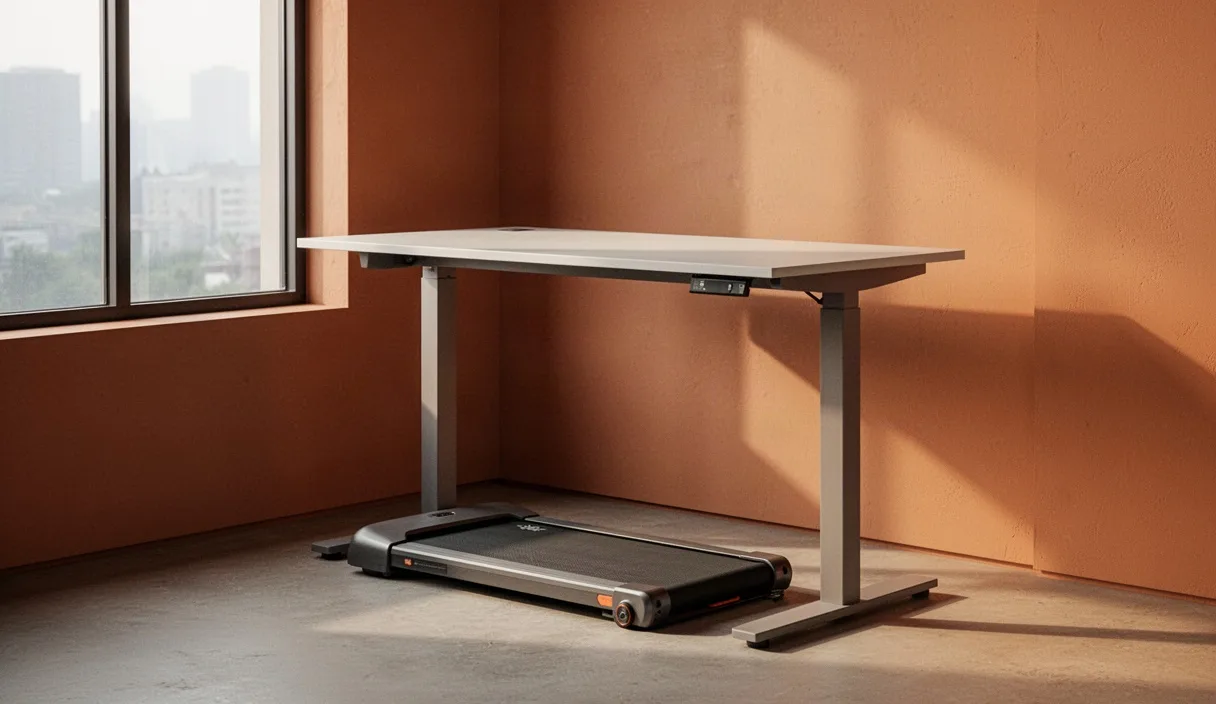
By contrast, under-desk treadmills paired with height-adjustable desks introduce continuous, low-velocity locomotion to tasks historically performed in complete stillness. While both configurations seek to interrupt uninterrupted sedentary time, their mechanical demands on the human body diverge sharply. Evaluating whether an office environment benefits more from static standing or motorized ambulation requires looking past generic notions of activity and examining energy expenditure, motor control stability, and spinal kinematics under daily operational constraints.
The Metabolic Inefficiency of Static Standing
The primary critique of the sit-stand converter rests on a simple metabolic reality: standing still is remarkably close to sitting down. When an individual transitions from an ergonomic task chair to an upright, static posture, the caloric differential measured by indirect calorimetry rarely exceeds eight to fifteen kilocalories per hour. A typical desk worker burning roughly seventy-five kilocalories per hour while seated will expend approximately eighty-five to ninety-two kilocalories per hour while standing still. Over an eight-hour shift, alternating between these postures yields an energy differential equivalent to a handful of raw almonds.
Beyond this minor energetic variance, motionless standing introduces hemodynamic complications that sitting occasionally avoids. Without the rhythmic contractions of the calf musculature to activate the skeletal muscle pump, venous blood pools in the lower extremities. Prolonged static standing increases hydrostatic pressure in the saphenous veins, leading to transient peripheral edema in the ankles, subjective sensations of lower-limb heaviness, and elevated vascular fatigue. The body remains sedentary in every functional cardiovascular metric, save for the passive isometric engagement of the postural antigravity muscles.
| Metric | Seated Desk Work | Static Standing Converter | Treadmill Ambulation (1.6 km/h) |
|---|---|---|---|
| Mean Energy Output | 72 to 84 kcal/h | 83 to 94 kcal/h | 175 to 220 kcal/h |
| Venous Return Mechanism | Passive, minimal | Hydrostatic stagnation | Active skeletal muscle pump |
| Gastrocnemius Activation | Negligible | Low isometric tone | Cyclic concentric/eccentric |
| Postural Shift Frequency | Low | High (frequent weight shifting) | Continuous regulated cadence |
These vascular and energetic metrics clarify why compliance rates for sit-stand converters drop off precipitously after purchase. Workplace audits routinely find that within three months of installation, users keep their converters in the lowered seated position for over ninety percent of the workday. Standing in place is physically uncomfortable without providing the physiological dividends that justify the discomfort.
Locomotor Energetics at Speeds Under Two Kilometers per Hour
Integrating a motorized belt under an adjustable surface converts passive upright posture into active locomotion. At belt speeds between 1.2 and 1.8 kilometers per hour, the metabolic equation shifts decisively. This velocity, roughly one-third of a standard outdoor walking pace, moves the worker out of basal metabolic territory into a light-intensity physical state without crossing the ventilatory threshold that induces perspiration or heavy respiration.
At an average speed of 1.6 kilometers per hour, gross energy expenditure rises to roughly 185 to 215 kilocalories per hour for an individual weighing seventy-five kilograms. More importantly, the respiratory exchange ratio remains within an aerobic substrate utilization zone. The steady mechanical demand triggers systemic insulin sensitivity pathways, notably the translocation of GLUT4 glucose transporters in skeletal muscle tissue, which remains largely dormant during static standing. Postprandial glucose excursions are blunted more effectively through continuous slow ambulation than through intermittent standing periods of equal duration.
Crucially, this speed tier preserves thermoregulation within air-conditioned workspaces maintained at twenty to twenty-two degrees Celsius. Operating a treadmill desk above two kilometers per hour generally increases core temperature enough to require moisture-wicking apparel, which is impractical in professional environments. Sub-two-kilometer pacing represents the physiological sweet spot where metabolic benefits occur without imposing athletic demands that disrupt the office setting.
Typing Accuracy and Fine Motor Skills During Slow Ambulation
The biomechanical viability of the treadmill desk hinges on upper-extremity stabilization. When walking, the head, torso, and shoulder girdle experience three-dimensional oscillations: vertical displacement, lateral sway, and anteroposterior acceleration. These micro-movements threaten the fine motor coordination required for precise keyboard transcription and pointer navigation.
Empirical trials measuring transcription output demonstrate that keyboard entry while walking at 1.4 kilometers per hour incurs an initial typing speed penalty of roughly six to nine percent, alongside an error rate increase of four to eleven percent among novices. In contrast, users operating sit-stand converters exhibit no measurable deficit in typing speed or accuracy relative to seated baselines, provided the desktop surface is positioned at correct elbow height.
- Keystroke latency: Intermittent belt heel-strikes generate minor micro-vibrations through the forearm, momentarily disrupting spatial awareness over home-row keys.
- Mouse pointing precision: Fitts's Law tasks, such as selecting small interface targets or selecting spreadsheets cells, show a twelve to seventeen percent increase in movement time during ambulation.
- Compensatory bracing: Users frequently attempt to stabilize their hands by anchoring their carpal tunnels against the desk edge, inadvertently raising intracarpal canal pressure.
- Cognitive task interference: High-bandwidth cognitive tasks, such as mathematical modeling or dense syntax editing, suffer when combined with walking, whereas passive reading, audio communication, and administrative triage remain unaffected.
Motor adaptation occurs over several weeks. Experienced treadmill desk users typically regain near-baseline typing accuracy by modifying their contact style, favoring a floating wrist technique reminiscent of classical piano playing. Nevertheless, for tasks demanding micro-precision, such as vector graphic illustration or intricate computer-aided design, the motionless platform of a converted desk retains an unassailable physical advantage.
Postural Alignment and Lumbar Compression Trade-Offs
Neither intervention provides an automatic remedy for spinal pathology; each presents its own distinct musculoskeletal trade-offs. Sit-stand converters reduce the sustained flexion of the lumbar spine characteristic of slumped sitting. However, when users grow fatigued while standing statically, they routinely default to asymmetric weight-bearing, protruding the abdomen, rotating the pelvis, and hanging on the posterior hip ligaments. This asymmetric posture introduces unilateral shear forces across the lumbosacral junction and exacerbates facet joint compression.
The treadmill desk enforces continuous, rhythmic pelvic rotation, preventing the static pelvic tilting common to prolonged standing. The alternating activation of the iliopsoas, gluteal complex, and active vitality spinae encourages dynamic spinal nutrition via intermittent fluid exchange across the intervertebral discs. For individuals whose lower back discomfort is provoked by static axial loading, the dynamic motion of slow ambulation often feels markedly better than remaining fixed atop an anti-fatigue mat.
Conversely, treadmill desks introduce repetitive ground reaction forces. Over a ninety-minute walking session at 1.5 kilometers per hour, a user registers approximately four thousand five hundred heel strikes on a relatively stiff walking deck. If the user wears unsupportive dress shoes or lacks adequate damping beneath the belt, those transient forces travel through the calcaneus, tibiofemoral joint, and hip capsule straight into the lumbar spine. Workers managing active plantar fasciitis, advanced knee joint mobility, or acute lumbar radiculopathy should avoid treadmill desks until a licensed physical therapist or occupational health physician evaluates their kinetic chain.
A Realistic Workday Schedule for Dynamic Desk Utilization
Deploying a treadmill desk or a sit-stand converter successfully requires moving away from all-or-nothing extremes. Attempting to walk for six hours on day one causes deep plantar fatigue, sore hip flexors, and cognitive exhaustion. A structured approach matches specific working modalities to the appropriate physical state throughout the day.
- Morning Administrative Block (Walking): Dedicate the first forty-five to sixty minutes of the workday to sorting email, reviewing task queues, and participating in passive morning standup meetings at 1.4 to 1.6 kilometers per hour.
- Mid-Morning Deep Analytical Block (Seated): Lower the desk to a standard ergonomic chair position for ninety to one hundred twenty minutes. Reserve this phase for complex writing, data analysis, or fine motor design where cognitive processing must not compete with locomotor rhythm.
- Pre-Noon Communication Block (Static Standing): Raise the platform to an upright, stationary position for thirty minutes before lunch. Use this brief interval for phone calls, quick document sign-offs, and short administrative check-ins.
- Post-Lunch Glycemic Clearance Block (Walking): Return to the treadmill roughly thirty minutes after lunch for forty-five minutes at 1.5 kilometers per hour to smooth postprandial glucose response and counter afternoon drowsiness.
- Late Afternoon Focus Block (Seated): Return to the seated configuration for the final stretch of technical production, preventing cumulative lower-limb fatigue from degrading late-day work output.
Common Mistakes
The most widespread mistake when using a treadmill desk is setting the belt speed too high. Users regularly adjust the unit to 2.5 or 3.0 kilometers per hour in search of an athletic workout. At this speed, lateral torso sway increases exponentially, typing accuracy collapses, and the user begins to sweat in office clothing, turning a productive workstation into an inefficient gym replacement.
With sit-stand converters, the dominant error is improper forearm and monitor alignment. Because many desktop converters rest directly on top of an existing desk, they introduce a minimum platform height increase of three to six centimeters even in their fully collapsed position. For shorter workers, this lifts the keyboard above resting elbow height, forcing protracted shoulder abduction and chronic trapezius strain while seated. In the standing position, workers frequently fail to raise the integrated monitor arm independently, causing a downward cervical gaze angle that strains the posterior neck muscles.
Footwear oversights undermine both setups. Operating a treadmill desk in hard-soled dress shoes, unsupportive flats, or high heels alters the kinetic chain and concentrates peak forces on the forefoot and knees. Similarly, standing barefoot on hard commercial carpet over concrete surfaces quickly causes plantar fascial strain. Footwear for ambulation desks requires neutral arch support, an adequate toe box, and sufficient midsole shock absorption.
Implementation Protocols and Ergonomic Verification
Before introducing a dynamic workstation to an office space, verify the physical parameters of the environment. Treadmill motor housings typically require eighty to one hundred centimeters of clearance under the desk frame, and the deck itself raises the user's standing height by eight to thirteen centimeters. Verify that your sit-stand desk frame has sufficient upward travel to position the keyboard tray precisely at ninety-degree resting elbow height while you stand on top of the elevated treadmill deck.
If you choose a sit-stand converter, weigh your desktop peripherals before buying. Many entry-level gas-spring converters carry a weight limit of twelve to fifteen kilograms. Exceeding this with dual heavy displays can cause the lifting mechanism to fail or drop unexpectedly. Furthermore, ensure the converter provides a separate, lower tier for the keyboard and mouse, preventing wrist extension injuries.
Begin dynamic desk interventions gradually. Introduce treadmill ambulation in twenty-minute intervals every other day, tracking localized fatigue in the arch of the foot, Achilles tendon, and lower back. If persistent musculoskeletal pain develops at any joint in the lower limbs or along the spine, stop using the dynamic setup and consult a certified professional ergonomic specialist or medical practitioner to review your posture, equipment heights, and biomechanical tolerances.